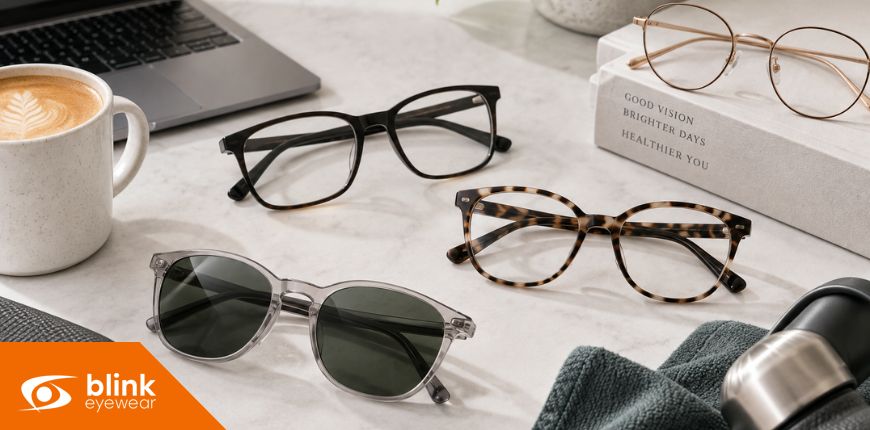
The right eyeglasses should do more than help you see clearly. Your frames and lenses should also complement your lifestyle, daily routine, personal style, and visual needs. Someone who spends most of the day working at a computer may benefit from different lens features than someone who drives frequently, plays sports, or spends significant time outdoors. Frame material, fit, lens design, coatings, and prescription requirements can all influence how comfortable and practical your glasses feel throughout the day.
At Blink Eyewear, choosing new eyeglasses is a personalized experience. Our team can help you find frames that suit your face, style, prescription, and everyday activities while explaining lens options that can make your vision more comfortable. From lightweight everyday frames and digital lenses to prescription sunglasses and premium eyewear, there are options for different needs and preferences.
START WITH YOUR DAILY ROUTINE
It is easy to begin shopping for eyeglasses by asking one question: Which frames look best?
Style matters, but the better place to start is your lifestyle.
Think about a typical day. How many hours do you spend looking at a computer? Do you drive frequently? Are you constantly moving between indoor and outdoor environments? Do you exercise in your glasses? Are you looking for one versatile pair, or would several pairs better support different parts of your routine?
These questions can help narrow down your options before you even start comparing frame shapes.
Someone working in an office, for example, may spend hours switching between a laptop, multiple monitors, a phone, and people across the room. Comfortable vision at several distances can become particularly important. Depending on the person's prescription and age, an optometrist may recommend lenses designed around those visual demands.
Someone who drives regularly has different priorities. Clear distance vision is essential, while glare and changing light conditions may also influence lens choices. Prescription sunglasses can provide another practical option for daytime driving and outdoor activities.
For active patients, frame fit becomes especially important. Glasses that constantly slide down your nose or feel unstable during movement can quickly become frustrating. Lightweight materials, secure temples, and an appropriate bridge fit can make eyewear much more comfortable.
Parents choosing glasses for children have another set of considerations. Kids need frames that can handle school, playgrounds, sports, backpacks, and everyday wear. Comfort is also essential because even the most durable pair of glasses will not help if a child does not want to wear them.
Consider these factors before choosing your next pair:
- Work: Screens, meetings, reading, detailed tasks
- Driving: Distance vision, glare, changing light
- Outdoors: Sun exposure and prescription sunglasses
- Activity: Movement, exercise, sports, durability
- Comfort: Weight, bridge fit, temple pressure
- Style: Colour, shape, material, overall appearance
- Routine: How many hours you wear glasses each day
Your prescription also affects what frames may work best.
Some stronger prescriptions can produce thicker lenses, particularly toward certain areas of the lens. Choosing an appropriate frame size and shape can help manage lens thickness and overall appearance. High-index lens materials may also provide a thinner and lighter option for certain prescriptions.
This is why selecting eyeglasses in Calgary is not simply a fashion decision. The best pair should balance how you want to look with how you actually live.
At Blink Eyewear, our team can help connect those two priorities. Instead of choosing a frame in isolation, we consider how it works with your prescription, facial proportions, comfort preferences, and daily activities.
Your glasses may be one of the first things you put on every morning and one of the last things you take off at night. They should be designed for the life you actually lead.
MATCH YOUR FRAMES TO YOU
Once you understand what your glasses need to do, you can focus on how you want them to look and feel.
Frame selection is personal. Two people can try on the same pair and have completely different reactions because facial proportions, colouring, prescription, personal style, and comfort all influence how a frame works.
Start with fit.
A well-fitting frame should sit comfortably on your nose without excessive pressure or slipping. The temples should feel secure without squeezing the sides of your head, and the frame should generally remain stable when you move.
Your eyes should also sit appropriately within the lenses. Proper positioning matters because your prescription lenses need to be accurately measured and centred for your eyes.
Frame width is another consideration. Frames that are too narrow may create pressure around the temples, while oversized frames may slide or feel unstable. The bridge design can also make a significant difference, particularly because faces and noses come in many different shapes.
Once the fit is right, style becomes much easier to explore.
Different frame shapes can create completely different looks. Rounded frames can feel softer or more creative, while angular frames often create a sharper, more structured appearance. Thin metal frames can offer a minimal aesthetic, while thicker acetate designs can make eyewear a more prominent part of your style.
Colour also changes the personality of a frame.
Classic black, tortoiseshell, metallic, and neutral colours are versatile, but eyewear can also be an opportunity to introduce colour or pattern into your everyday wardrobe. There is no universal rule saying certain face shapes must wear certain frames. The best choice is one that fits properly and makes you feel comfortable and confident.
Material matters too.
Acetate frames offer a wide range of colours, patterns, and shapes. Metal frames can provide a lighter or more understated look. Different materials also vary in weight, flexibility, durability, and adjustability.
For many patients, owning more than one pair makes sense.
You might choose:
- A polished pair for work
- A casual everyday frame
- Prescription sunglasses
- A statement frame for personal style
- A backup pair
- Eyewear designed around specific activities
Think of glasses in the same way you might think about footwear. One pair can be versatile, but you probably would not expect the same shoes to be ideal for the office, running, a formal event, and the beach.
Your eyewear can be similarly personalized.
A professional who wants a subtle frame during client meetings might choose something clean and refined for work while keeping a more expressive pair for evenings and weekends. Someone who treats glasses as an important part of their personal style may prefer several frames that complement different outfits.
At Blink Eyewear, our approach to eyewear is personalized rather than pressure driven. The goal is not simply to find something that technically fits. It is to help you find glasses that feel like they belong on you.
That can mean trying something outside your usual style, comparing different materials, or seeing how a frame looks from different angles rather than making a decision based only on the mirror directly in front of you.
The best frame is the one you will be happy to reach for tomorrow morning.
CHOOSE LENSES THAT WORK HARDER
Frames get most of the attention, but your lenses ultimately determine how you see through your glasses.
Two pairs of glasses can look nearly identical while providing very different visual experiences depending on the lenses inside them.
Your starting point should always be an up-to-date prescription from a comprehensive eye exam. Once your prescription and eye health have been assessed, your optometrist and eyewear team can help determine which lens options make sense for your needs.
Single-vision lenses provide one prescription throughout the lens and may be used for distance, near, or another specific visual task.
As people develop presbyopia, they may need help seeing across multiple distances. Progressive lenses can incorporate distance, intermediate, and near vision into one pair without the visible segment associated with traditional bifocals.
Lens design and measurements become particularly important with progressives. Your frames need to fit appropriately, and precise measurements help position the different viewing areas correctly.
Digital lens technology can provide additional customization based on the prescription, frame, and measurements. For patients with demanding visual routines, these refinements can contribute to a more personalized lens experience.
Lens materials also deserve consideration.
Depending on your prescription, high-index lenses may reduce thickness and weight. Impact-resistant materials can be useful for children, active lifestyles, or certain safety needs. Your eyewear provider can explain the trade-offs between different materials based on your prescription and how you use your glasses.
Coatings can further customize your lenses.
Anti-reflective coatings can reduce distracting reflections and improve the cosmetic appearance of lenses. Scratch-resistant treatments can help protect surfaces during everyday use. UV protection is also an important consideration for outdoor eyewear.
For people who frequently move between indoor and outdoor settings, photochromic lenses may offer added convenience by changing tint in response to ultraviolet exposure. They are not the right choice for everyone, but they can be useful for certain lifestyles.
Prescription sunglasses remain another valuable option. They provide clear vision while allowing you to wear dedicated sun protection rather than placing non-prescription sunglasses over your regular glasses.
If screens are a major part of your day, talk to your optometrist about your working distances and symptoms rather than automatically choosing a lens based on marketing claims. Headaches, fatigue, dryness, or difficulty focusing can have different causes. Understanding what is actually contributing to your discomfort helps guide more appropriate recommendations.
This is also why your eye exam and eyewear selection should work together.
A comprehensive examination establishes what your eyes need. Your lenses translate that prescription into usable vision. Your frames position those lenses correctly while supporting comfort and personal style.
All three pieces matter.
At Blink Eyewear, we help patients bring them together. Whether you are looking for an understated everyday pair, premium frames, children's eyewear, prescription sunglasses, or lenses suited to a screen-heavy workday, our team can help you compare options without turning the process into guesswork.
Choosing glasses should be fun, but it should also be thoughtful.
Start with your lifestyle. Find a frame that fits your face and personality. Then choose lenses that support the way you actually use your eyes.
When those elements work together, your glasses become more than vision correction. They become a comfortable, practical, and personal part of your everyday life.
If it is time for a new prescription or you are ready to find your next pair, visit Blink Eyewear for a comprehensive eye exam and personalized eyewear fitting. Our team can help you find eyeglasses that look great, feel comfortable, and work for the way you live.