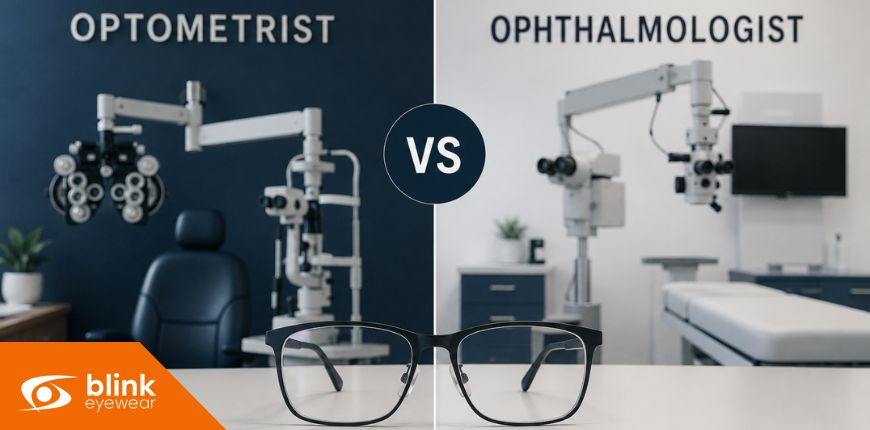
When something changes with your vision, knowing who to book an appointment with is not always obvious. Should you search for an eye doctor in Calgary, book an optometrist, or see an ophthalmologist? While these terms are sometimes used interchangeably, each professional has a different role in protecting your vision. For most routine and preventative eye care, an optometrist is the place to start. Optometrists provide comprehensive eye exams, update prescriptions, assess eye health, diagnose and manage many eye conditions, and help determine when specialized medical or surgical care is needed.
At Blink Eyewear, our optometrists combine personalized care with modern diagnostic technology to look beyond how clearly you can read an eye chart. Regular exams can uncover subtle changes sometimes before you notice symptoms yourself.
KNOW WHICH EYE CARE PROFESSIONAL TO CALL
The term "eye doctor" can be confusing because people often use it to describe both optometrists and ophthalmologists. While both professionals care for your eyes, their training and the services they provide are different.
For most people, an optometrist is their primary eye care provider. Optometrists perform comprehensive eye exams, prescribe glasses and contact lenses, evaluate eye health, diagnose and manage many eye conditions, and provide ongoing preventative care. They can also assess urgent eye concerns and refer patients to other medical professionals when specialized treatment is required.
An ophthalmologist is a medical doctor who specializes in diseases and surgery of the eye. Ophthalmologists often manage complex eye diseases and perform procedures such as cataract surgery, retinal surgery, and other surgical treatments. Patients may be referred to an ophthalmologist when their condition requires medical or surgical care beyond what can be provided in an optometry clinic.
There are also opticians, who have another important role in eye care. Opticians specialize in fitting and dispensing prescription eyewear based on a prescription provided by an optometrist or ophthalmologist. They can help you choose frames, take precise measurements, and ensure your glasses fit comfortably and provide the vision correction prescribed for you.
Understanding these roles makes it easier to decide where to start. If you are simply due for an eye exam, need a new prescription, are interested in contact lenses, or have noticed a change in your vision, booking an optometrist is generally an appropriate first step.
A comprehensive eye exam can include much more than determining whether your prescription has changed. Your optometrist may assess:
- Visual clarity and prescription
- Eye coordination and focusing
- Eye pressure
- Retina and optic nerve health
- Peripheral vision when indicated
- Signs of common eye conditions
- Dry eye symptoms and eyelid health
At Blink Eyewear, technology can also play an important role in understanding what is happening inside your eyes. Digital retinal imaging, OCT scans, and other diagnostic testing can provide detailed information that cannot be gathered from a basic vision check alone.
This is particularly important because healthy-feeling eyes are not always healthy eyes. Some conditions develop gradually and can cause little or no noticeable change during their early stages. Regular appointments give your optometrist an opportunity to establish a baseline and compare your eye health over time.
For Calgary families, this means you do not need to wait until something feels wrong to see an eye doctor. Preventative care is one of the most valuable reasons to make eye exams part of your regular healthcare routine.
SEE AN OPTOMETRIST FOR MOST EYE CONCERNS
There are many reasons you might decide it is time to book an eye exam in Calgary. Some are obvious, such as blurry vision or broken glasses, while others can be surprisingly subtle.
One of the most common reasons is a change in prescription. You may notice that road signs are harder to read, screens look blurry, or you need to hold your phone farther away. Children might squint, sit closer to the television, complain of headaches, or struggle to see the board at school.
These are all good reasons to see an optometrist.
You should also consider booking an appointment if you experience frequent headaches, tired eyes, difficulty focusing, light sensitivity, persistent dryness, or changes in night vision. These symptoms can have several possible causes, and an eye exam can help determine whether your vision or eye health is contributing.
Optometrists also play an important role in detecting and monitoring eye conditions. Depending on your individual needs and findings, an examination can look for signs associated with glaucoma, cataracts, macular degeneration, retinal concerns, and other conditions.
Modern diagnostic technology provides another layer of information. For example, digital retinal imaging captures detailed pictures of the back of the eye, including the retina and optic nerve. These images can be stored and compared from one appointment to the next.
OCT, or optical coherence tomography, provides high-resolution cross-sectional images of retinal structures. This can help your optometrist examine different retinal layers and optic nerve fibres in greater detail.
That year-to-year comparison can be particularly valuable. Rather than looking at your eyes as a single snapshot in time, your optometrist can identify patterns and subtle changes that may deserve closer attention.
Optometrists can also help when the concern is more immediate.
Sudden flashes or floaters, painful red eyes, foreign objects, eye injuries, abrupt changes in vision, or other unexpected symptoms may require urgent assessment. Depending on the situation, an optometrist can examine the problem, provide treatment within their scope of practice, or determine whether you require immediate referral to an ophthalmologist or hospital.
For contact lens wearers, regular optometry appointments are important even when the lenses feel comfortable. Contact lenses sit directly on the surface of the eye, so your optometrist needs to evaluate their fit, your corneal health, and whether your current lenses remain appropriate.
Children also benefit from regular optometric care. A child may not recognize that their vision is different from everyone else's, especially if they have never experienced clearer vision. Comprehensive exams can identify refractive errors and other visual concerns that might otherwise go unnoticed.
For adults, eye care needs continue to change with age. Near vision commonly becomes more difficult, prescriptions may shift, and the risk of certain eye conditions increases. Regular exams allow your care to evolve with those changes.
The important point is that you do not need to diagnose yourself before booking an appointment. If something feels different, or you simply want to stay proactive, an optometrist can assess your eyes and guide you toward the appropriate next step.
MAKE REGULAR EYE EXAMS PART OF YOUR HEALTHCARE
Choosing the right eye care professional becomes much simpler when you think of your optometrist as your first point of contact for routine vision and eye health.
A regular comprehensive eye exam provides an opportunity to discuss your vision, lifestyle, family history, medications, existing health concerns, and any symptoms you may be experiencing. That context helps your optometrist personalize the examination rather than treating every patient exactly the same way.
Your lifestyle matters more than you might think. Someone who spends eight hours a day working on multiple monitors may have different visual demands than someone who drives frequently, works outdoors, plays competitive sports, or wears contact lenses every day.
The same applies to families. Children's vision needs can change quickly as they grow, while adults may require different types of lenses or closer monitoring as they age. Personalized eye care takes these differences into account.
At Blink Eyewear, the goal is to make that care feel approachable rather than intimidating. Patients should understand what is being tested, why it matters, and what their results mean. Advanced technology is valuable, but it becomes even more useful when paired with clear explanations and a provider who takes the time to understand your needs.
That approach is especially important when an exam identifies something unexpected.
If your optometrist sees a finding that requires further investigation, they can explain what was observed and recommend the appropriate next step. In some situations, that may simply mean monitoring the area more closely. In others, additional testing or a referral to an ophthalmologist may be appropriate.
This collaborative approach means seeing an optometrist does not prevent you from accessing specialized care. Instead, your optometrist can help you navigate the eye care system and determine when another professional should become involved.
Regular eye exams also create a valuable record of your eye health. Digital images, prescriptions, measurements, and clinical findings collected over several appointments provide context that a single examination cannot. If something begins changing, having previous information available can help your optometrist recognize that change sooner.
So, who should you see?
If you need a routine eye exam, updated glasses or contact lenses, preventative eye health assessment, children's vision care, or an evaluation of a new eye concern, start with an optometrist. If your condition requires specialized medical treatment or surgery, your optometrist can help coordinate the appropriate referral.
If you are searching for an eye doctor in Calgary because it has been a while since your last appointment, Blink Eyewear makes comprehensive care convenient for individuals and families. Our team combines personalized attention with modern eye care technology to evaluate both how well you see and how healthy your eyes are.
Do not wait for blurry vision to make eye health a priority. Contact Blink Eyewear to book a comprehensive eye exam and give your eyes the regular care they deserve.